
Articles
Democratising advanced analytics
Oil and gas companies are familiar with dealing with the industry’s many unpredictable challenges: volatile markets, tightening environmental regulations, offsetting ageing oilfields—to name just a few key concerns. The difference now, however, is that the industry is also undergoing a shift towards greater digitalisation.
And, with this digitalisation, new and increasingly potent technological innovations allow companies to increase operational resilience, reduce energy consumption and improve asset uptime through process and asset efficiencies. Combined, these innovations can help play an invaluable role in monitoring and reducing emissions.
Consider aspects that support companies in reaching the following goals:
- Increasing operational resilience.
- Cutting energy consumption.
- Reducing deferment/increased asset uptime
- Improving asset efficiency.
- Monitoring and reducing emissions.
Which one is most important to you to reach operational excellence? Whatever your answer, fully utilising your plant’s production data is key. And it is through using this data that oil and gas companies can reduce emissions and meet future environmental commitments.
Informed decision-making
Today, it is no longer just about storing huge amounts of captured process data; the problem is actually knowing how to use it appropriately to make data-driven decisions. Organisations know this, and the usual line of thinking goes something like this: “We need more business insights from our data, so we should hire more data scientists. But there are not enough data scientists. What can we do?”
One solution is to fully leverage your organisation’s data to empower the process experts who can interpret it best. And this can be achieved by democratising the data using self-service analytics tools, which allow these experts to analyse the data themselves.
Using pattern recognition and machine learning, self-service industrial analytics allows users to tap directly into enormous amounts of time-series data, and also contextualise it with data from other business applications to fully understand it. As a result of democratising both data and analytics, substantial insight and value can be realised.
Large volumes of data captured during production also include time-series data and other process information, which is often siloed in business applications. Self-service analytics tools facilitate better use of this plant data.
Another feature of self-service analytics is the ability to create multiple dashboards for visualisation of processes. These dashboards help summarise the time-series and contextual data, prioritise areas of interest and start performance investigations.
Equally, this tool can be used as a valuable open solution for global organisational collaboration because it is scalable, employs a plug-and-play property management system connection, and has flexible deployment options and seamless integration.
Monitoring & reducing emissions
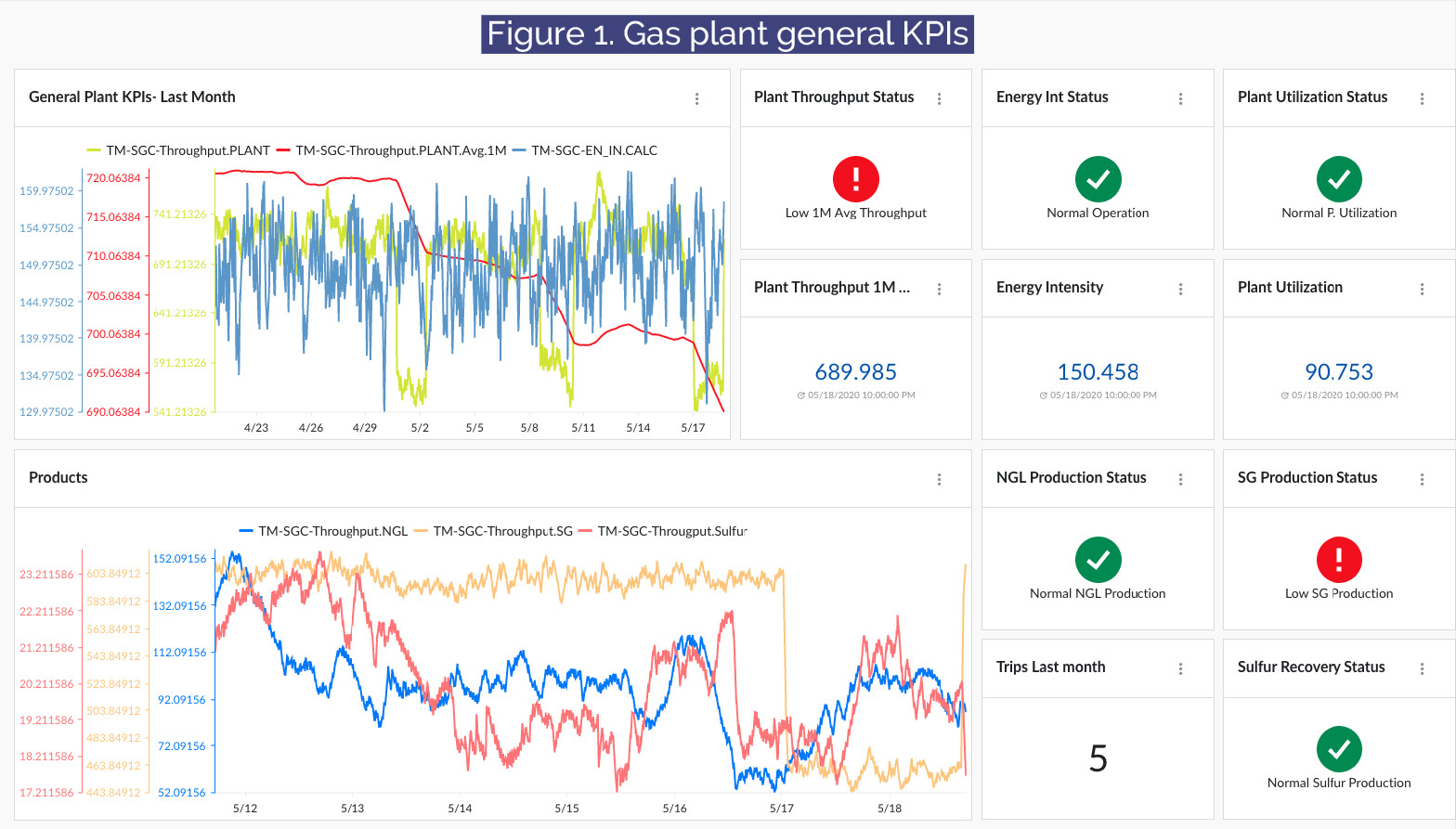
Self-service analytics can also be used to address operators’ carbon footprints. As an example, process experts looked at the general key performance indicators of an oil and gas company to try to determine how emissions could be reduced (see Fig. 1).
These specialists used a self-service analytics tool to analyse emissions data for the past six months. They wanted to know, in particular, how many times in the last week the plant had a high emissions event. Drilling down into the data, they saw the flaring of one flow was marked high. The researchers used high throughput correlation engine software called a recommendation engine to investigate if there was a specific tag that correlated. The software showed that one stack was increasing at the same time as emissions increased.
The next step was to see how many times this event happened during the past six months. Using the pattern recognition functionality of the analytics tool, the process experts saw that, when the valve closed too quickly, flaring also increased dramatically.
To avoid this from happening in the future, a monitor was set that would send an email alerting the personnel in charge of the asset, allowing them to take immediate preventive actions.
Democratising the analytics resulted in real value. Process experts could use their knowledge along with the self-service analytics tool to optimise operations without any need for modelling. Critical valve reliability improvements were realised, and proactive monitoring was implemented. As a result, both emissions and process safety risk were sharply reduced.
The missing piece
Self-service analytics are key for oil and gas organisations to become data-driven and to move towards net-zero operations because they democratise both data and analytics. Designed for process experts, these tools empower the personnel who know best about their processes to analyse all of their plant data without needing to rely on data scientists.
Self-service analytics also provide process experts with valuable operational insights and facility improvements that help boost economic performance. Moreover, these tools allow for vertical team integration to build operational resilience, enhance operational excellence, and help benchmark production locally and globally. The end result is a central knowledge platform that enables global collaboration and a truly data-driven organisation.
Julian Pereira is head of customer success Emea at software company TrendMiner
Author: Julian Pereira<br>TrendMiner
Related Articles
Connect with H2Tech
