
Articles
Saudi Arabia sees Irena’s hydrogen vision
Saudi Arabia, possibly the country with the most to lose from the energy transition, appears to be siding with the International Renewable Energy Agency (Irena) when it comes to the future of hydrogen. In a recently released preview of World Energy Transitions Outlook, Irena has painted a bright future for hydrogen in its preferred 1.5°C Scenario (1.5-S)—its vision on how to achieve the Paris Agreement’s stretch goal.
On 21 March, Saudi Aramco CEO Amin Nasser announced plans to "expand and intensify" cooperation with China on blue hydrogen research, after the Kingdom signed a memorandum of understanding establishing hydrogen cooperation with the German government earlier in the month. This builds on Saudi Arabia’s stated goal of being the global leader in clean hydrogen production and exports in coming decades.
Irena’s hydrogen vision
The primary foil for 1.5-S in Irena’s outlook is the Planned Energy Scenario (PES), based on governments’ announced energy plans and related targets and policies as of 2019. According to Irena, holding the global temperature increase to 1.5°C above pre-industrial levels by end of century requires net-zero carbon dioxide (CO2) emissions by 2050, with a rapid decline in emissions beginning now.
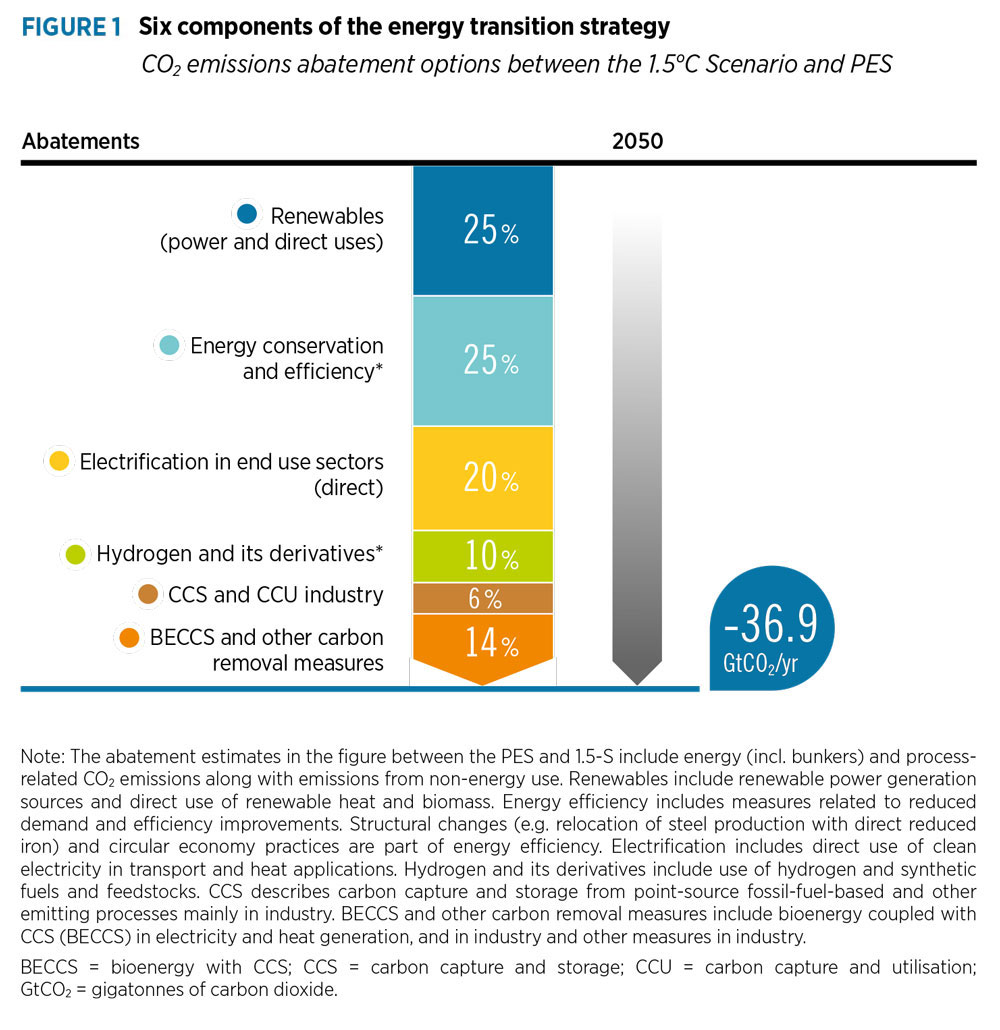
As can be seen in Fig. 1, hydrogen and its derivatives, such as e-ammonia and e-methanol, are a key driver for the abatement of CO2 emissions in 2050, accounting for a tenth of needed reductions in 1.5-S compared with PES. This is significantly less than energy conservation and efficiency improvements, renewables for power and direct uses, and electrification of end-use sectors—but almost twice as much as carbon capture, utilisation and storage.
At the same time, hydrogen becomes the third-most important energy carrier over the next three decades under 1.5-S (see Fig. 2). At 12pc of total final energy consumption (TFEC) in 2050, hydrogen trails electricity and modern biomass—at 51pc and 18pc respectively—but its share is 2pc greater than the three fossil fuels combined.
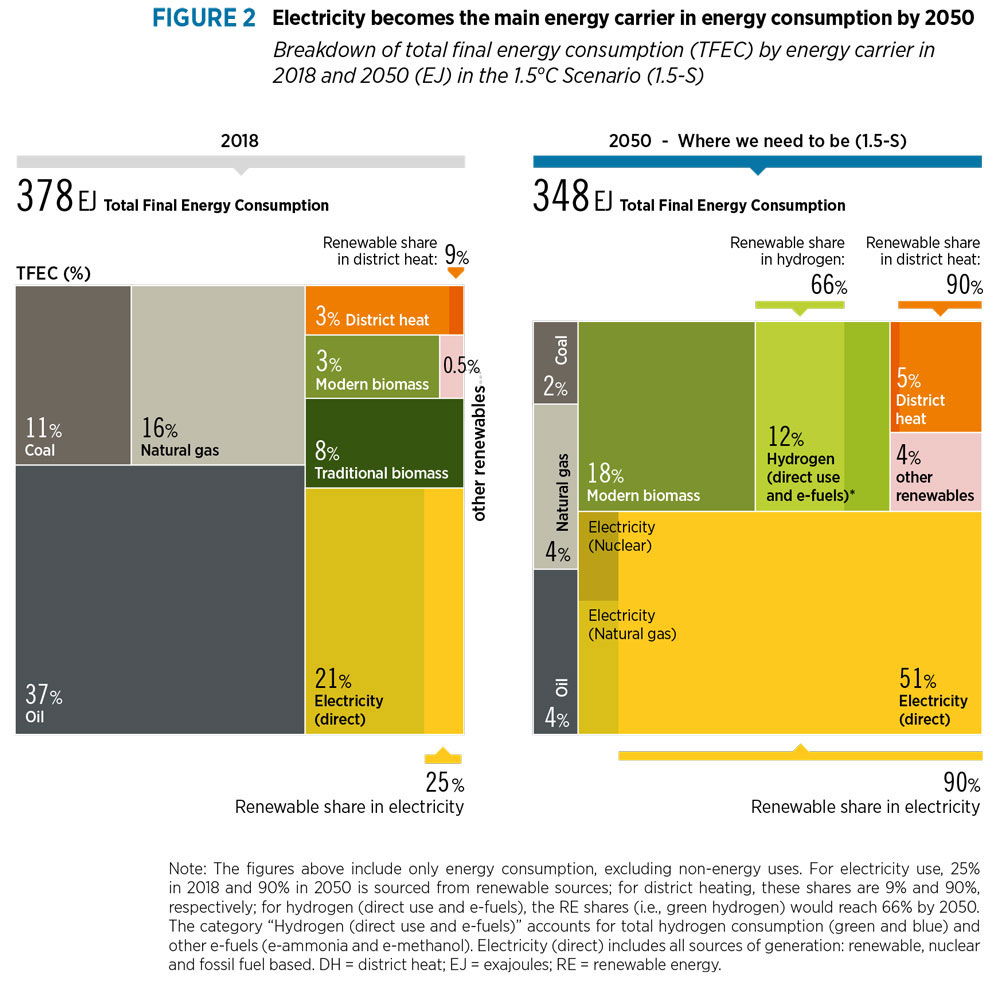
Green hydrogen accounts for almost two-thirds of total hydrogen in 2050 under 1.5-S, with blue hydrogen produced from natural gas and some sort of carbon capture the rest. Irena is forecasting the cost of green hydrogen to fall below blue hydrogen in many locations within the next 5-15 years, as electrolysers and renewable electricity continue to become cheaper.
It is important to note that hydrogen also indirectly contributes to electricity’s share of TFEC, given its role in electrifying modes of transportation through the use of fuel-cell technology and the use of e-fuels such as ammonia and methanol in power generation (see Fig. 3).
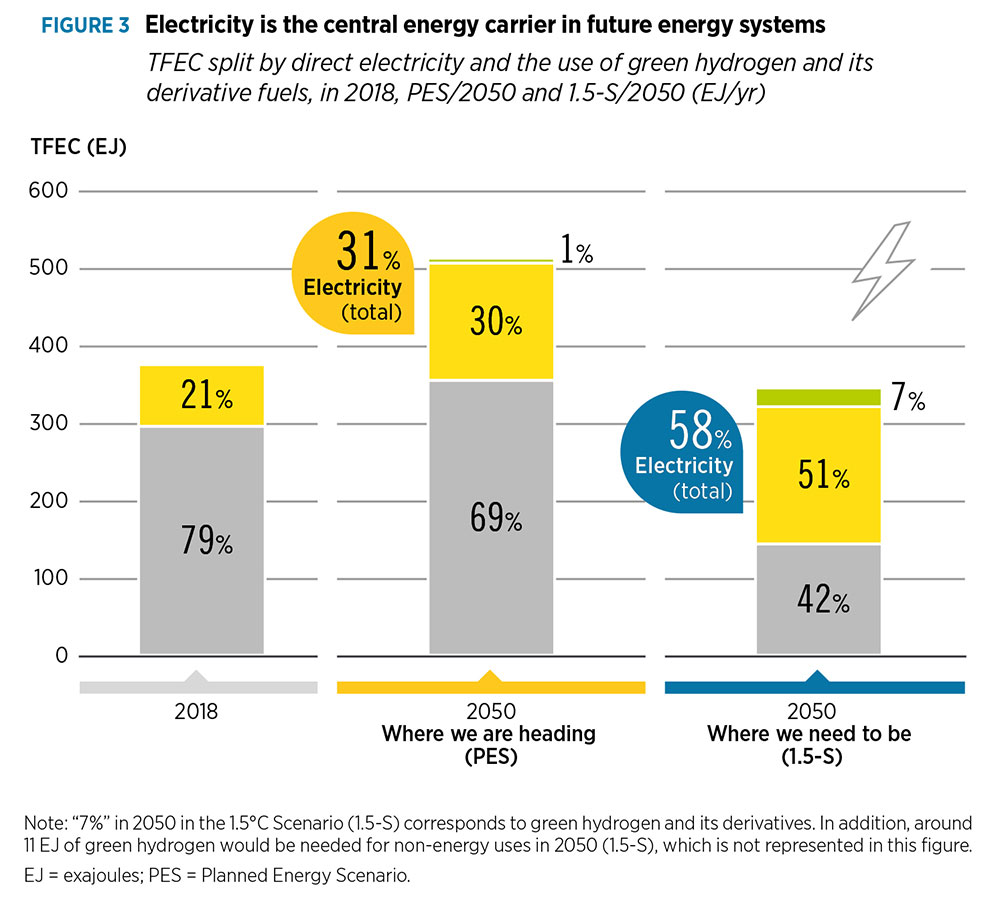
Under PES, hydrogen’s share is a modest 1pc in 2050, after being negligible in 2018, increasing electricity’s direct and indirect share to 31pc—10pc more than 2018. By contrast, under 1.5-S, hydrogen increases to 2pc by 2030 and 7pc by the end of the period, pushing total electricity to 58pc of final energy use.
On the flip side, the electricity needed to produce green hydrogen and its derivatives under 1.5-S will reach almost 21,000TWh by 2050, 30pc of global electricity consumption, and close to today’s total. This will require hydrogen electrolyser capacity of almost 5,000GW compared with just 0.3GW presently.
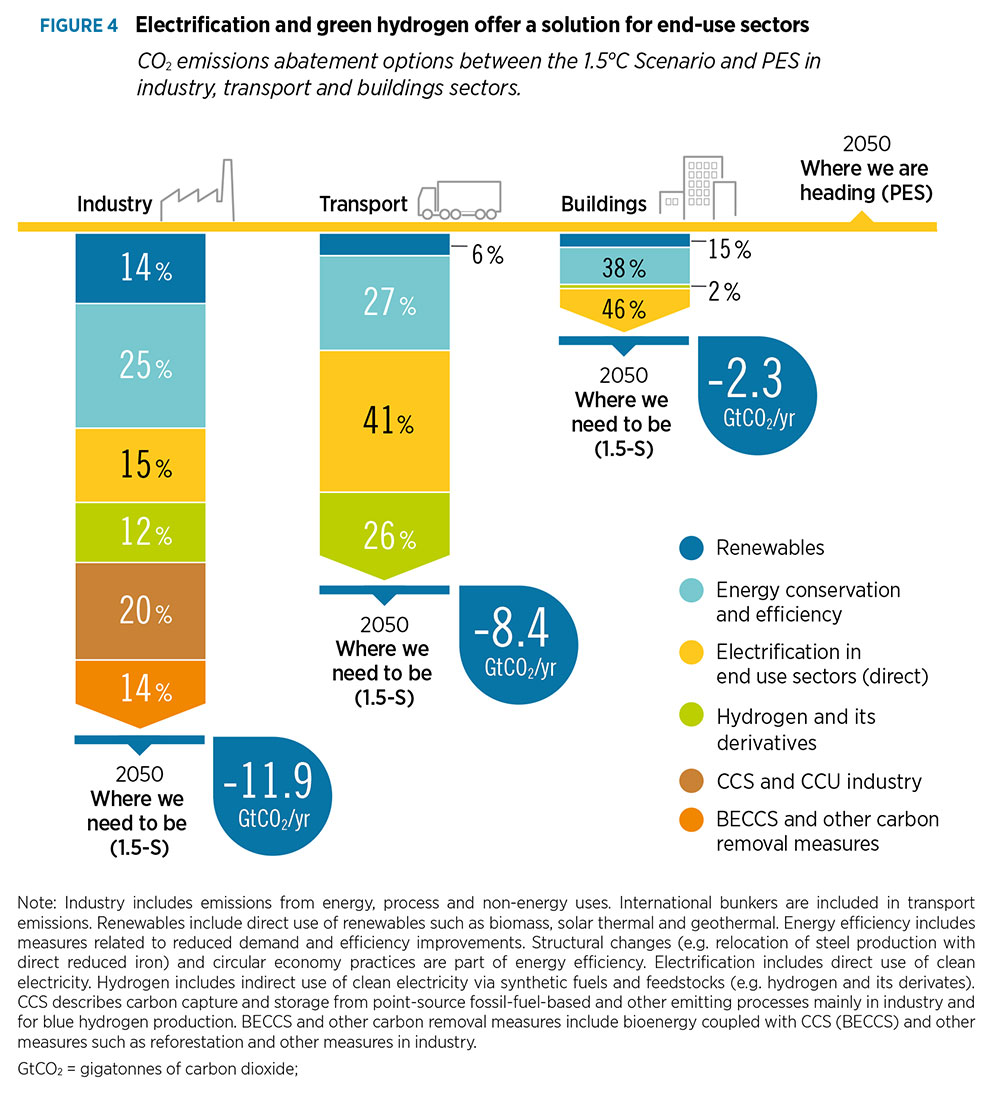
As can be seen in Fig. 4, hydrogen and its derivatives will cut CO2 emissions from transportation—especially medium- and heavy-duty trucking, air, marine and rail—by over a quarter in 1.5-S compared to PES by 2050, abate 12pc of emissions from industry—steel-making, and less so cement and mining—but none for buildings.
Author: Vincent Lauerman
Related Articles
Connect with H2Tech
