
Articles
Compressed hydrogen a potential option for shipping
Ships carrying compressed hydrogen could help the nascent international hydrogen market grow by offering scalability, according to shipping firm Global Energy Ventures (GEV).
Hydrogen is expensive and difficult to ship, and no single technology has yet emerged as the most cost-effective solution. Most hydrogen shipped internationally is first converted into ammonia, but this method has high reconversion costs, and some technical issues still remain in attaining hydrogen pure enough for use in proton-exchange membrane fuel cells.
Liquefied hydrogen is often viewed as the natural successor to ammonia as export markets build and the costs of the technology come down.
“A key advantage of C-H₂ ships is scalability, allowing the size of ship to grow with market size” Carolan, GEV
But one of the advantages of compressed hydrogen (C-H₂) ships is that their capacities can be scaled to the size of the market, whereas liquefied hydrogen ships must be relatively large to be economic, according to Martin Carolan, GEV managing director, tells Hydrogen Economist.
“A key advantage of C-H₂ ships is scalability, allowing the size of ship to grow with market size,” Carolan tells Hydrogen Economist.
GEV, in collaboration with Vancouver-based Ballard Power Systems, is developing a C-H₂ ship to transport low-carbon hydrogen. GEV’s shipping method has lower projected costs than moving liquefied hydrogen for routes up to 4,500 nautical miles (8,300km), according to Carolan.
Shipping liquefied hydrogen
In a report released last, year titled Path to hydrogen competitiveness: A cost perspective, industry association the Hydrogen Council indicated liquefied hydrogen was the most likely method for raw hydrogen to be economically shipped by sea in the future. To support this viewpoint, the council provided an outlook for landed costs for liquefied hydrogen in probable major import markets, provided by global consultancy McKinsey & Company.
Hydrogen shipping routes laid out by McKinsey tend to be relatively short haul, since the cost of shipping liquefied hydrogen remains high in 2030—about five times the cost of shipping LNG on an energy-equivalent basis. For example, the consultancy is projecting the cost of shipping liquefied hydrogen from Saudi Arabia to Japan to be $1.70/kg in 2030, assuming sufficient scale, compared with a hypothetical cost of about $15/kg for this route in 2020.
At least two companies are presently working on constructing commercial-scale bulk carriers for liquefied hydrogen—Japan’s Kawasaki Heavy Industries (KHI) and Korea Shipbuilding & Offshore Engineering. KHI completed a small-scale prototype, the Suiso Frontier, in December 2019. The ship is undergoing sea trials, with the first voyage from Japan to Australia and back—around 9,000 km—expected in the coming months.
Shipping compressed hydrogen
In contrast, GEV’s C-H₂ ship design is relatively straightforward and, as a result, should have significantly lower operating losses and fixed capital costs, according to Carolan. It has fewer stages in the supply chain than liquefaction and ammonia conversion, most of its technologies are readily available and the design has minimal technical hurdles. What hurdles there are should be surmounted in the next 18-24 months, he adds. This has allowed the company to obtain approval in principle from US regulatory body the American Bureau of Shipping for the vessel’s containment system, based on a cargo capacity of 2,000t of hydrogen, in mid-March.
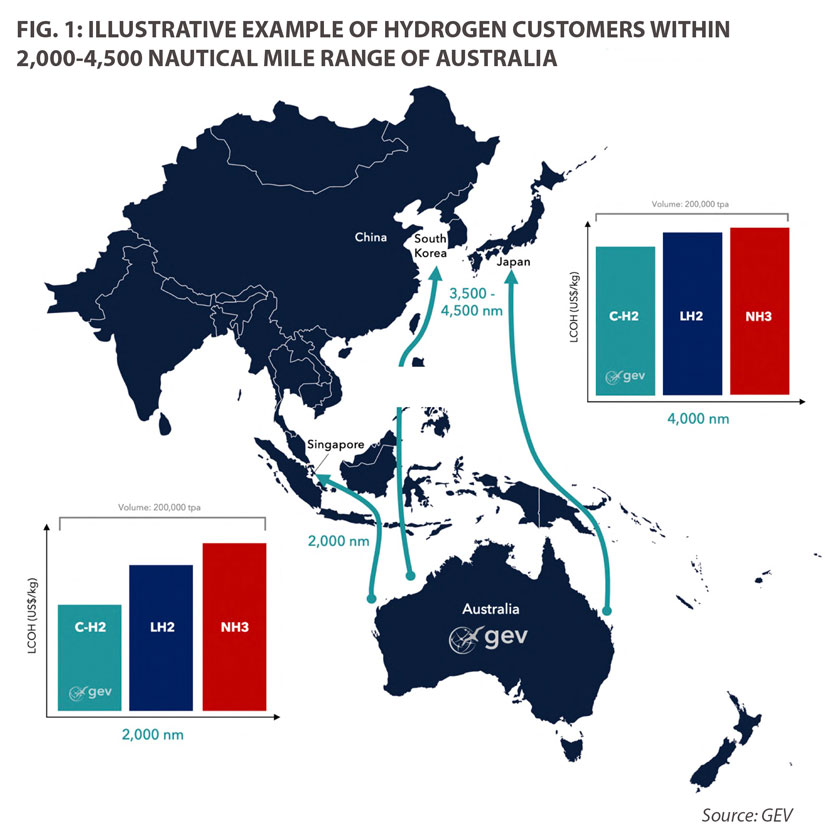
GEV released results of a scoping study at the beginning of March showing a C-H₂ ship of this size should have a substantial cost advantage over its competitors for voyages of 2,000 nautical miles, and a modest one at 4,000 nautical miles (see Fig. 1). The economics of compressed hydrogen ships are negatively impacted for longer-haul voyages because of the amount of hydrogen they can transport for a given vessel size, with liquefied hydrogen ships able to carry three times more cargo and ammonia ones five times more.
On 7 June, GEV announced plans to launch a smaller scale C-H₂ ship, with a capacity of 430t, by the middle of this decade compared with late this decade for its first large-scale vessel. The company believes its ship design should be competitive for short-to-medium length voyages for hydrogen cargoes up to 4,000t.
Author: Vincent Lauerman
Related Articles
Connect with H2Tech
