
Articles
Hydrogen Economist looks at the new hydrogen projects added to our database and the progress made on existing developments (2)
Of the new projects, ten are in Europe (Germany, Italy, Netherlands, Spain, Sweden & the UK), five are in Asia-Pacific (Australia, Indonesia, South Korea & Vietnam), three are in North America (Canada & the US) and one is in South & Central America (Brazil).
In the Netherlands, Denmark’s Orsted is looking to link GW-scale electrolysis to the large industrial demand in the Dutch-Flemish North Sea Port cluster by 2030 with its SeaH2Land project. It is proposing to connect a 1GW hydrogen production facility to a new 2GW offshore windfarm in the Dutch North Sea, enabling the large-scale supply of renewable electricity required for the production of green hydrogen. The 1GW electrolyser will be connected to an envisaged regional pipeline system linking large-scale consumption and production in the cluster, where demand of 580,000t/yr of fossil-fuel derived hydrogen makes it one of the largest markets in Europe. The regional open-access pipeline will stretch about 45km across the area from Vlissingen to Ghent. The project offers the Netherlands and Belgium an opportunity to get closer to realising their 2030 climate goals by reducing carbon emissions in the industrial sector.
In the UK, Norway’s Equinor and SSE Thermal unveiled plans to jointly develop two low-carbon power stations in the Humber region, including the world’s first 100pc hydrogen-fuelled power plant. The two decarbonised facilities would form part of a “clean power hub” near Scunthorpe and would be among the first to utilise carbon capture and storage and hydrogen technologies. The 900MW Keadby 3 and 1,800MW Keadby Hydrogen would replace older, carbon-intensive generation on the grid, providing flexible power to support more intermittent renewable generation. The projects would utilise the parallel hydrogen and CO2 pipeline infrastructure being developed by the Zero Carbon Humber partnership.
In Brazil, state-owned utility Eletrobras signed a preliminary agreement with Siemens Energy for the development of a Green Hydrogen Pilot Plant. Eletrobras research and development unit Cepel is said to have been studying the production of green hydrogen for two decades. Eletrobras’ 51GW of installed—predominantly renewable—generation capacity gives it 30pc of Brazil’s total. The country is seen as a potential future hub for green hydrogen development in the continent, according to Siemens.
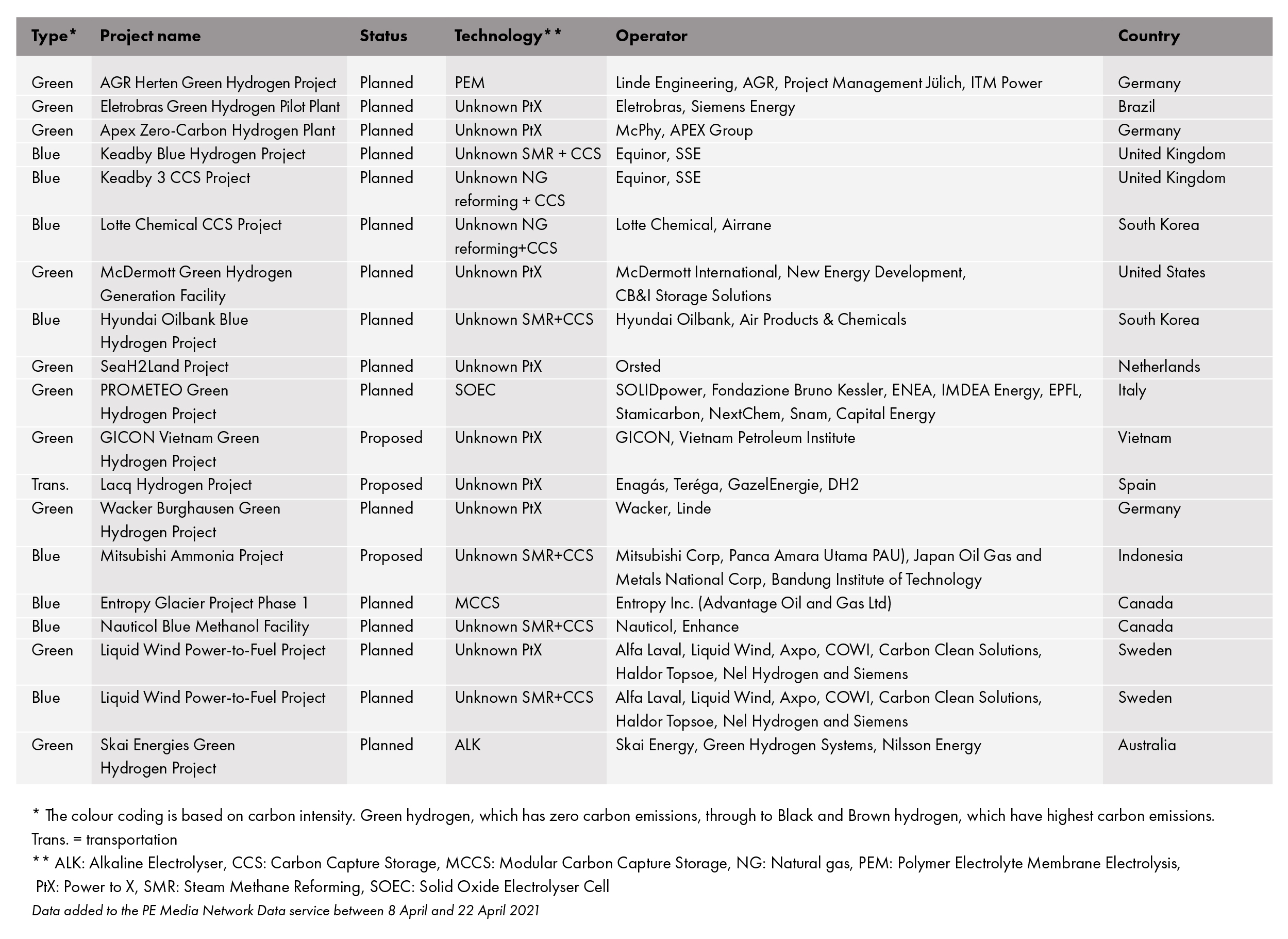
Comprehensive details can be found on the Hydrogen Data Service.

Related Articles
Connect with H2Tech
