
News
InterContinental Energy’s P2(H2)Node powers a new era of large-scale green fuels with ARENA funding, first license and patents in 50+ countries
- Perth-based InterContinental Energy (ICE) announced three major milestones for its P2(H2)Node™ architecture: securing Australian Renewable Energy Agency (ARENA) funding, signing the first license and expanding patents to more than 50 countries.
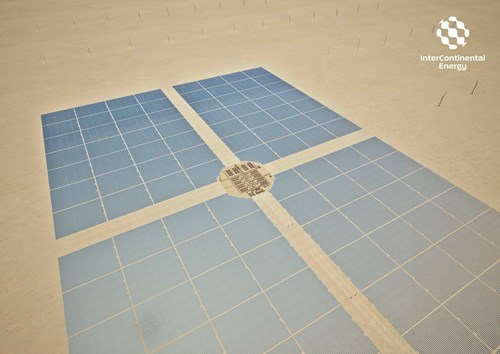
Under ARENA’s Advancing Renewables Program, ICE has secured up to $1.6 million in funding to develop a Digital Twin Optimization Framework for the P2(H2)Node. ARENA’s support will help create a standardised Digital Twin and licensable engineering design that developers can use to plan large-scale green fuel hubs.
These tools have the potential to improve design certainty, cut capital and operating costs by 10–20%, and shorten delivery timelines through digital simulation and standardisation that de-risk projects.
“ARENA’s support acknowledges the potential of the P2(H2)Node architecture and its role in accelerating large-scale green fuels, such as renewable hydrogen” said Richard D. Colwill,
Head of Engineering and Innovation at ICE. “We are advancing digital and engineering design work that gives developers and investors more certainty on cost, performance and timing, at a time when fuel security and AI power needs are front of mind.”
The P2(H2)Node is a patented modular architecture that integrates electrolysis plants directly with wind and solar farms, eliminating long-distance transmission, cutting costs and boosting efficiency. Standardised design and modular construction provide a blueprint for projects in coastal and remote regions, including future integration of data centres run on one hundred percent low-cost green energy. Recent customer interest is already driving this development pathway for the Node.
First P2(H2)Node licence signed
ICE has signed the first licence for the P2(H2)Node system architecture. The agreement will see the Node deployed on a large-scale renewable hydrogen project, providing an early reference case.
“This first licence is a significant milestone, moving the Node from concept to deployment,”
Richad Colwill said. “We expect it to serve as a model for future licences, enabling developers
to use a proven, optimised design rather than starting from scratch.”
ICE expects this licence to pave the way for further agreements with developers globally.
Global patent footprint
The P2(H2)Node architecture is now patented in more than 50 countries, including Australia, the United States, Canada, South Africa, Mauritania and Namibia. This portfolio underpins ICE’s long-term investment in innovation.
By combining modular design, optimised efficiency and integrated storage and transport, the P2(H2)Node aims to deliver lower production costs while supporting sectors including shipping and aviation e-fuels, fertilisers, green steel, and large-scale data centres.
From The Archives
Connect with H2Tech
